.jpg?width=200&height=135&name=PTL_Logo_Stacked_FS%20(2).jpg)
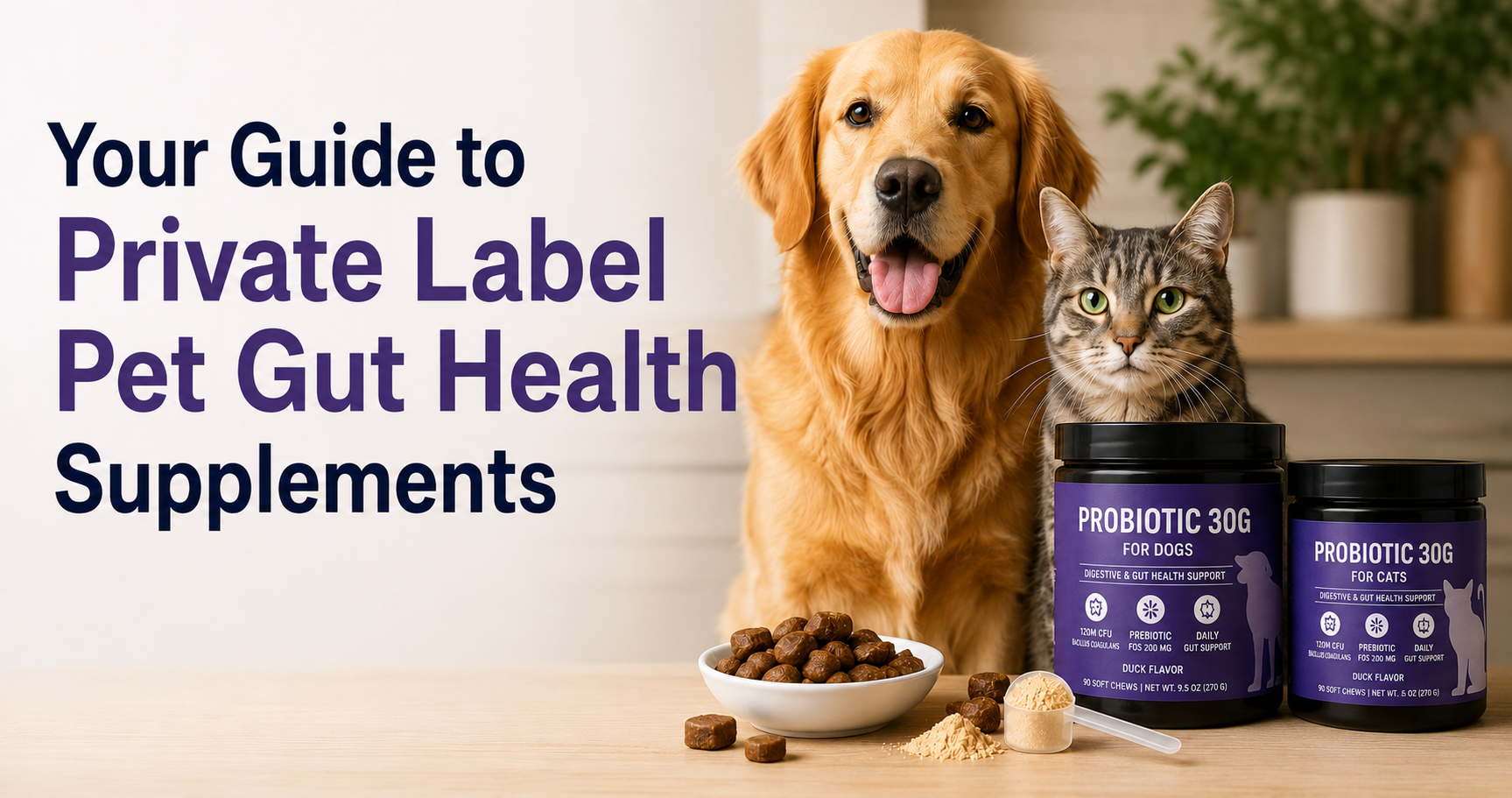
The pet supplement market has crossed into the mainstream. According to the American Pet Products Association, vitamin and supplement purchases for dogs have increased 56% since 2018, and for cats, 70%. Gut health is leading that charge.
For brands looking to enter or expand in the pet wellness space, a private-label pet gut health supplement is one of the most strategic starting points available. High repeat purchase rate. Broad appeal across species. And a product category that pet owners are already actively searching for and buying.
Here's what you need to know to do it right.
Gut health is a daily-use, high-repeat category with growing demand and low keyword competition. Here's what separates a product that works from one that just has a good label:
The Probiotic 30G from Pet Tech Labs is available for both dogs and cats. It's the anchor product for any brand entering the pet gut health category.
Gut health isn't a trend — it's a foundation. Research consistently shows that approximately 70% of the immune system resides in the gut. For pet owners who are increasingly treating their animals with the same proactive wellness mindset they apply to themselves, that connection matters.
Search behavior reflects it. Terms like "pet gut health supplement," "dog digestive health," and "cat digestive health" are pulling consistent monthly search volume with relatively low keyword difficulty — meaning pet owners are actively looking, and the competition for their attention hasn't yet hit the ceiling it has in human supplements.
From a business standpoint, gut health products sit in the daily-use category. A pet owner who adds a probiotic to their dog's or cat's routine doesn't buy once … they repurchase every 30 to 90 days. That repurchase cycle is what separates a transactional supplement sale from a recurring revenue model.
The timing is right. The demand is real. The question is how to build a product worth buying.
Not all probiotic formulas are equal, and the difference matters more in pet supplements than most categories. Strain stability is the first issue most brands never think to ask about.
Most probiotic strains are fragile. Heat, moisture, and the manufacturing process itself can kill live cultures before a product ever reaches the shelf. This is why the strain used matters as much as the CFU count printed on the label.
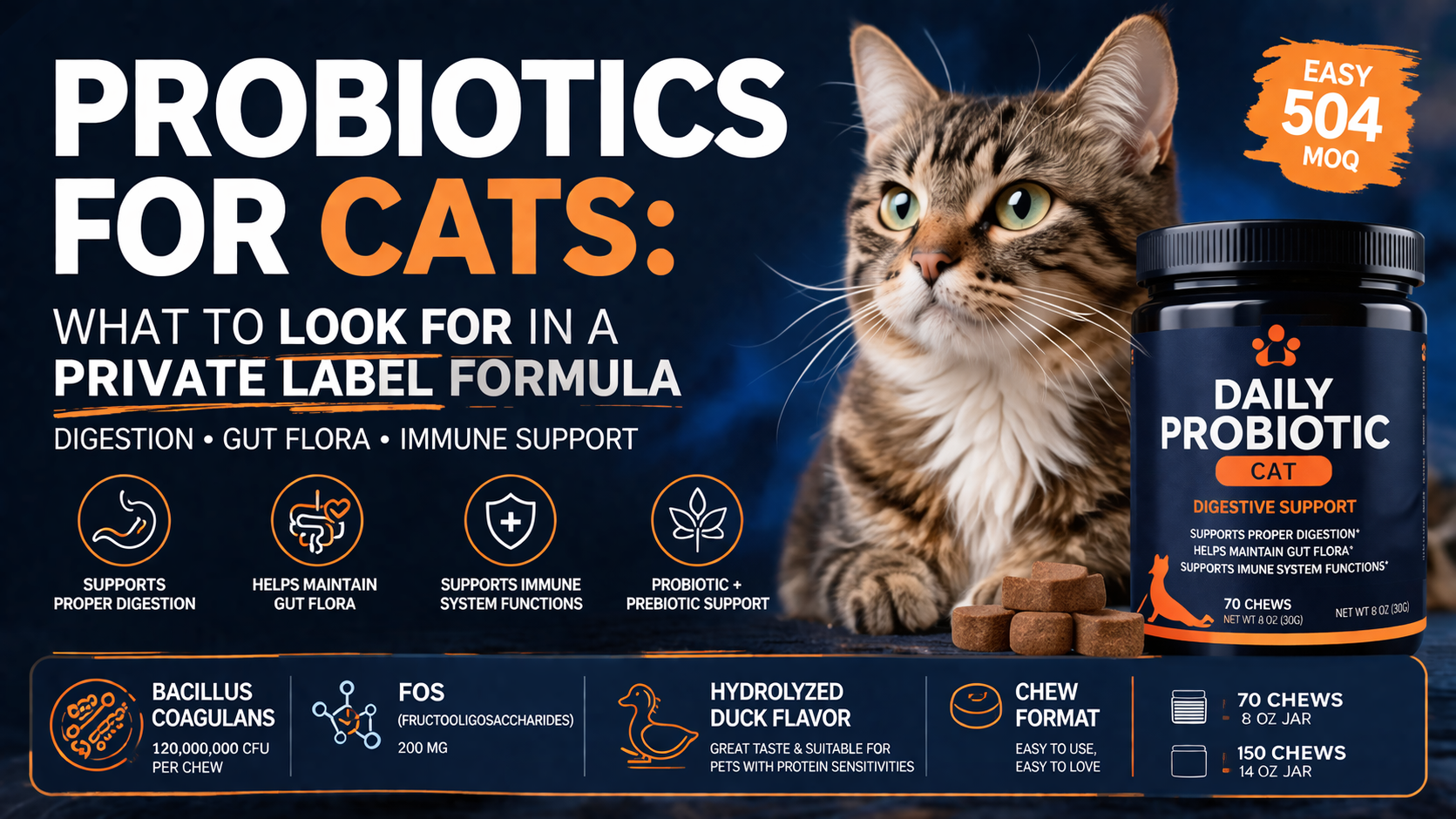
Bacillus coagulans is the only probiotic strain that is stable in a soft chew format. It survives manufacturing, survives shelf storage, and delivers live cultures at the point of digestion — which is the only place it counts. A product formulated with Bacillus coagulans at 120,000,000 CFU per chew delivers what it promises. Many products on the market do not.
The second element of a strong gut health formula is the prebiotic. Probiotics introduce beneficial bacteria and prebiotics feed them. Fructooligosaccharides (FOS) at 200mg per serving act as a fuel source for the microflora in the GI tract, amplifying the effect of the probiotic rather than letting it work in isolation.
Together, Bacillus coagulans and FOS create a synbiotic formula — one that supports both the introduction and the survival of healthy gut bacteria. That's the difference between a product that works and one that just has an impressive number on the label.
The formula also needs to solve a palatability problem, especially for cats. Hydrolyzed duck flavor addresses this directly — it's protein-sensitized pet-friendly, meaning it won't trigger reactions in animals with common protein allergies, and it's palatable enough that even finicky eaters will take it consistently. Compliance is everything in a supplement meant to be given daily.
Pet Tech Labs offers the Probiotic 30G — our best-selling gut health formula — in two formats: soft chew and granules. Both deliver the same active formula. The choice between them depends on your target customer and how you plan to position the product.
Soft chews are the stronger choice for most brands entering the category. They're perceived as a treat rather than a supplement, which drives daily compliance. Pet owners are more likely to maintain a consistent routine when the product feels like a reward. Chews also photograph well, have strong shelf presence in jar format, and are the format most pet owners already recognize from the brands they trust.
Granules offer a lower minimum order quantity entry point and work well for brands targeting cat owners specifically. Cats are notoriously resistant to anything that feels like a pill or a supplement added to their food — but granules can be mixed into wet food with less resistance than a chew a cat has to actively chew and swallow. For a brand launching a cat-specific gut health line, granules give you flexibility both in administration and in cost of entry.
Both formats are available through the White Label program at Pet Tech Labs, with the chew format available in 90ct and 160ct jars, and granules in 60ct, 90ct, and 120ct sizes.

The White Label program at Pet Tech Labs is built for brands that want to move fast without sacrificing quality. The formula is already developed, already validated, and already manufactured to cGMP standards in a Vermont facility that holds SQF certification and NASC founding member status. You're not starting from scratch — you're putting your brand on a proven product.
The process runs five steps:
1. Choose your products. Select from the ready-to-launch catalog. For gut health, the Probiotic 30G is the anchor — available for both dogs and cats, in chew and granule formats.
2. Submit your logos and artwork. Your brand identity goes on the label. Pet Tech Labs handles the production side.
3. Approve your label. Review and sign off before anything goes to print or production.
4. Place your order. Minimum order quantity starts at 504 units per SKU — a deliberate entry point designed for brands that want to test the market before committing to large inventory.
5. Receive your shipment. Timeline is weeks, not months. The accelerated launch is a core advantage of the White Label model over custom formulation, which requires R&D cycles that can stretch six months or longer.
For brands that want differentiation beyond what the White Label catalog offers, Pet Tech Labs also operates a Premium Program — custom R&D formulations starting at 400 lbs MOQ, with access to branded ingredients and elevated profiles. The White Label program is where most brands start. The Premium Program is where they go when they're ready to own something proprietary.
The supplement industry is not uniformly regulated, and the gap between what a label claims and what a product delivers is wider than most brand builders realize. Your manufacturer's compliance infrastructure is your brand's backstop.
When evaluating a private label pet supplement manufacturer, the certifications that matter are:
Pet Tech Labs, a FoodScience Company, holds all of these. Their Vermont facility has maintained these standards for over two decades. That compliance history is something a newer contract manufacturer simply cannot offer.
The fit is strong if any of these describe your situation:
You already sell to pet owners and want to add a high-repeat-purchase supplement SKU to your lineup. You're launching a pet brand and want to start with a category that has proven demand and a clear daily-use value proposition. You're specifically targeting the cat supplement space, where the market is underpenetrated relative to dogs and growing faster on a percentage basis.
What private label gut health is not a fit for: brands that want a one-time or occasional-use product, or brands for whom the 504-unit MOQ represents an inventory commitment they're not ready to make. In those cases, the conversation starts with understanding the business model before selecting the formula.
For brands that are ready, the path is clear. A proven formula, a compliant manufacturer, a format that works for both dogs and cats, and a category that pet owners are actively buying in every month.
Explore private label pet supplements from Pet Tech Labs, or get started with private label cat supplements if you're focused on the feline market. To talk through formula selection, MOQ, and timelines, connect with the Pet Tech Labs team at pettechlabs.com.

A private label pet gut health supplement is a pre-formulated product manufactured by a third party — like Pet Tech Labs — that you sell under your own brand name. The formula, production, and compliance are handled by the manufacturer. You provide the branding and go to market. White Label programs like the one at Pet Tech Labs start at 504 units per SKU, making them accessible for emerging brands without the cost or timeline of custom formulation.
Bacillus coagulans is a spore-forming probiotic strain that is uniquely stable under the heat and pressure of soft chew manufacturing. Most probiotic strains die during production, meaning the CFU count on the label overstates what actually reaches the animal's gut. Bacillus coagulans survives manufacturing and shelf storage intact, delivering live cultures at the point of digestion. It is the only probiotic strain that can be reliably formulated into a soft chew format.
A probiotic introduces beneficial bacteria into the gut. A synbiotic combines a probiotic with a prebiotic — a fiber that feeds the introduced bacteria and helps them establish in the GI tract. The Probiotic 30G is a synbiotic formula: Bacillus coagulans at 120,000,000 CFU paired with 200mg of fructooligosaccharides (FOS). The prebiotic amplifies the probiotic's effect rather than leaving it to compete unaided with existing gut flora.
The White Label program at Pet Tech Labs starts at 504 units per SKU. This applies to each size and format — chews and granules are separate SKUs with separate MOQs. The 504-unit minimum is designed to let brands test the market with manageable inventory before scaling to larger orders, where per-unit costs decrease.
The White Label program is built for speed. Once you've selected your products, submitted brand artwork, and approved your label, the timeline to shipment is typically weeks. Custom formulation through the Premium Program takes considerably longer due to R&D development cycles. For brands that need to move quickly, White Label is the right path.
The four certifications that matter most are cGMP (current Good Manufacturing Practices), SQF (Safe Quality Food certification), NASC membership (National Animal Supplement Council), and USDA APHIS export certification for brands selling internationally. Pet Tech Labs holds all four and has maintained these standards at their Vermont facility for over two decades — a compliance track record that newer manufacturers cannot replicate.
Yes. Pet Tech Labs offers the Probiotic 30G with species-specific SKUs for both dogs and cats. The active formula — Bacillus coagulans at 120,000,000 CFU and FOS at 200mg per chew — is consistent across species. Dosing differs: dogs are dosed at 1 chew per 25 lbs of body weight daily, while the cat version is dosed at 1 chew daily regardless of body weight. Both use hydrolyzed duck flavor, which is appropriate for pets with common protein sensitivities.
The White Label program uses pre-developed, validated formulas from Pet Tech Labs' Pet Naturals house brand. It's designed for fast market entry at 504-unit MOQ with a launch timeline of weeks. The Premium Program offers custom or enhanced formulations developed by Pet Tech Labs' R&D team, with access to branded ingredients and differentiated profiles. Premium MOQ starts at 400 lbs and involves a structured development process. Most brands start with White Label and graduate to Premium when they're ready to own a proprietary formula.
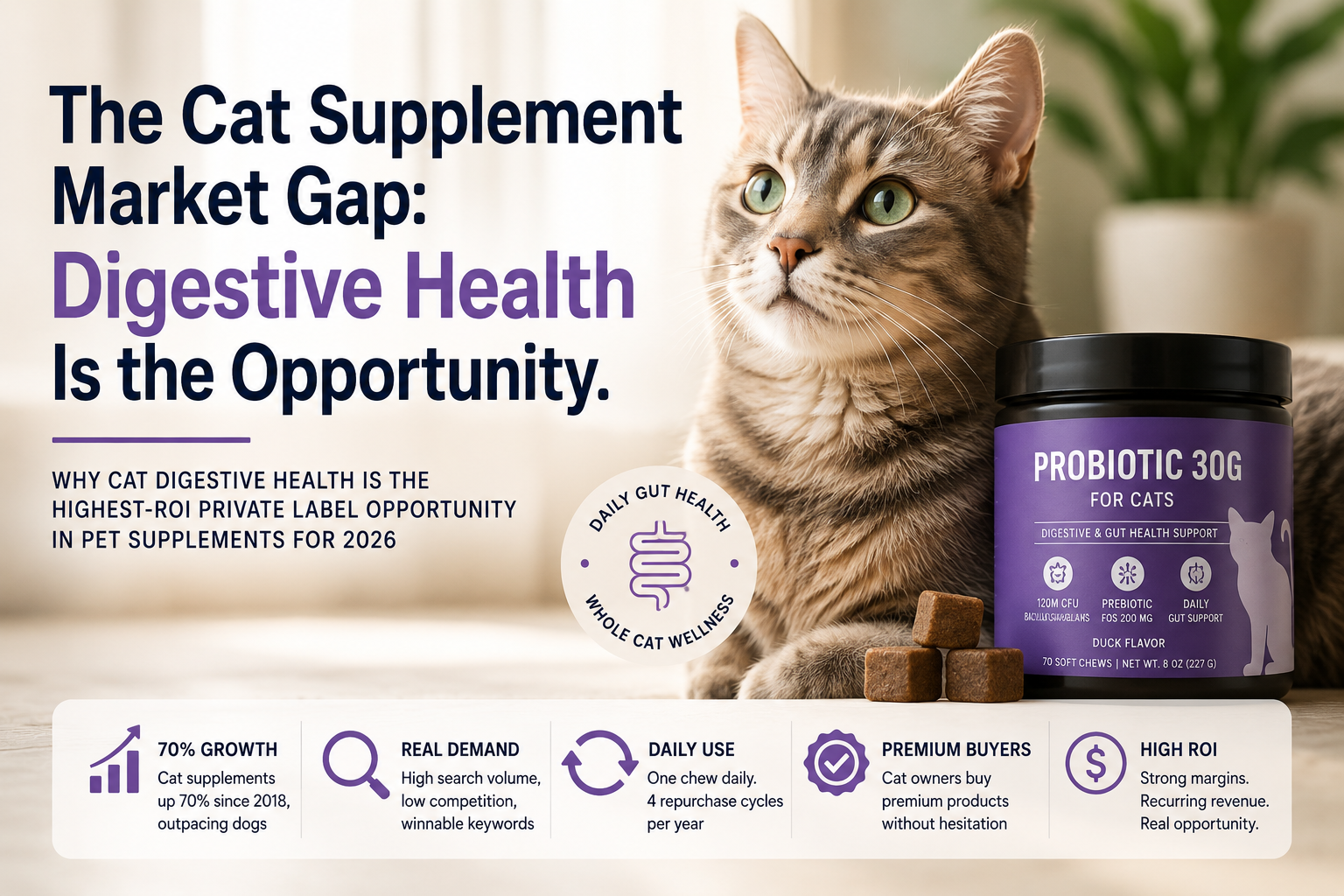
The 2026 pet supplement market has a gap, and it has whiskers. Dog supplements dominate the...
Pet Tech Labs Team
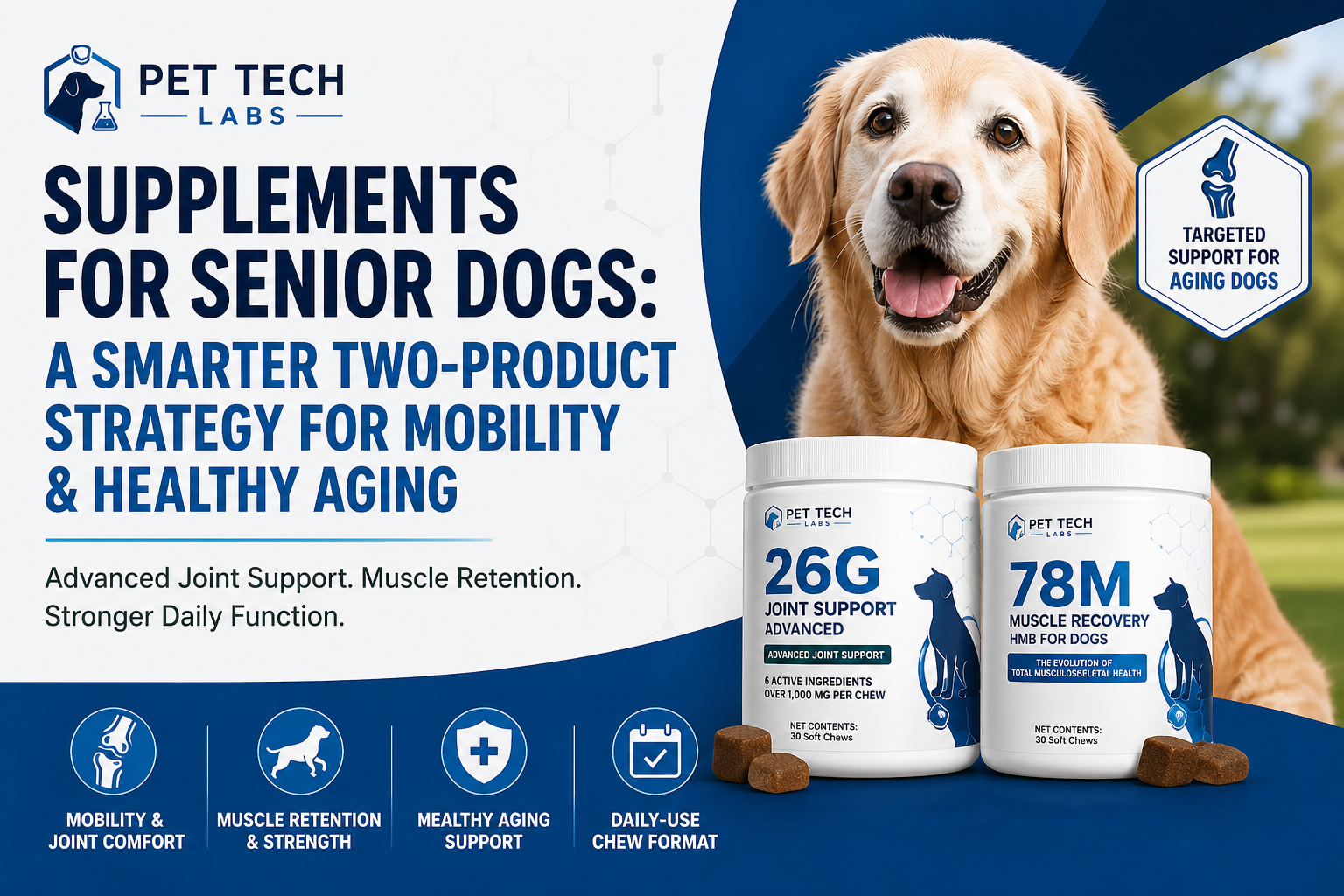
The phrase "supplements for senior dogs" sounds like one category. It is not. Aging dogs do not all...
Pet Tech Labs Team
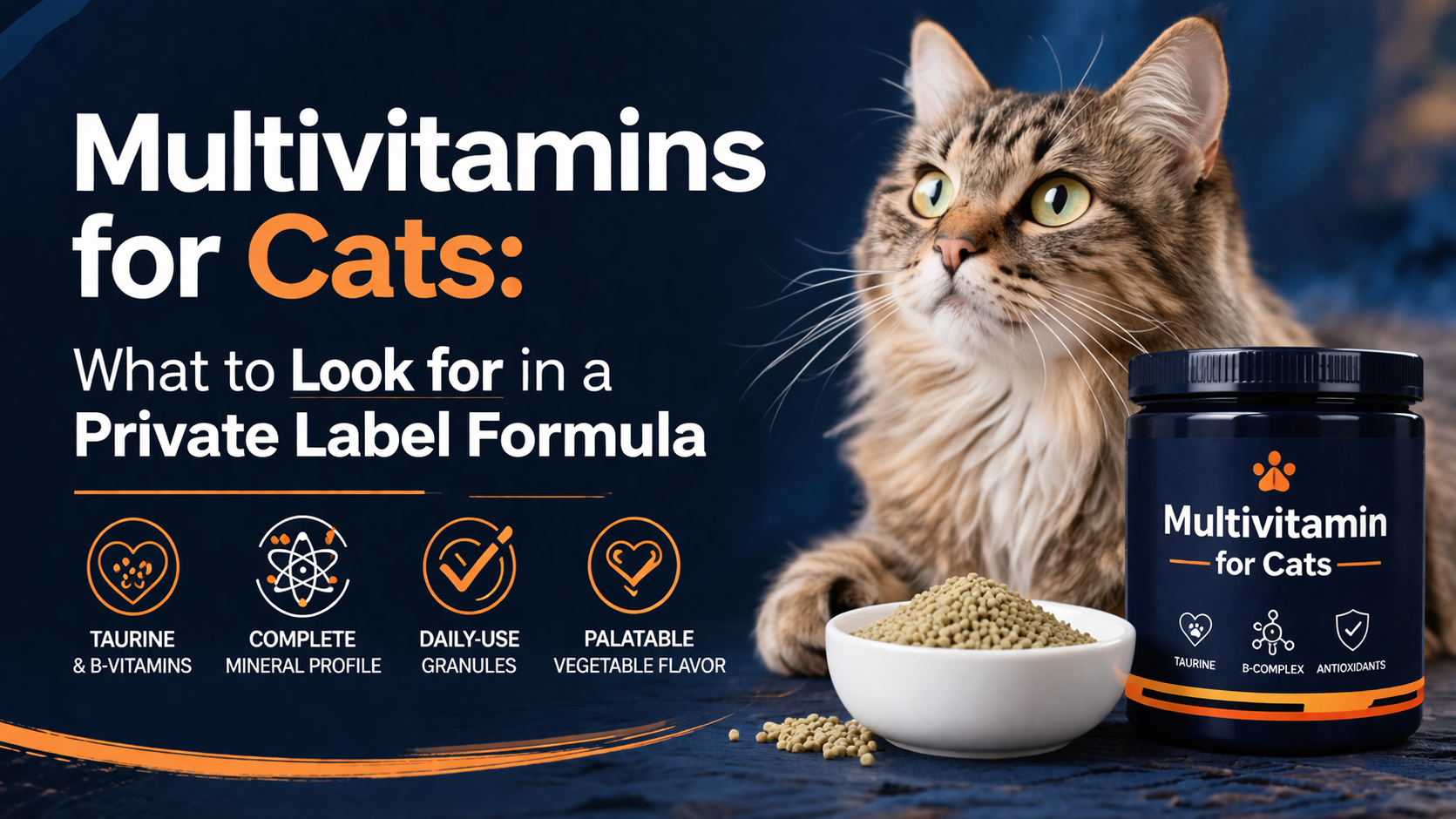
Quick Answer: What Should a Good Multivitamin for Cats Include? A strong multivitamin for cats...
Pet Tech Labs Team
A lot of probiotics for cats sound better on the front of the label than they do under a closer...
Pet Tech Labs Team
Pet Tech Labs® sets the gold standard for companies looking for top-quality pet supplements and private labeling or contract manufacturing solutions
Pet Tech Labs® is part of the FoodScience® family of brands. Learn more at foodsciencecorp.com