.jpg?width=200&height=135&name=PTL_Logo_Stacked_FS%20(2).jpg)
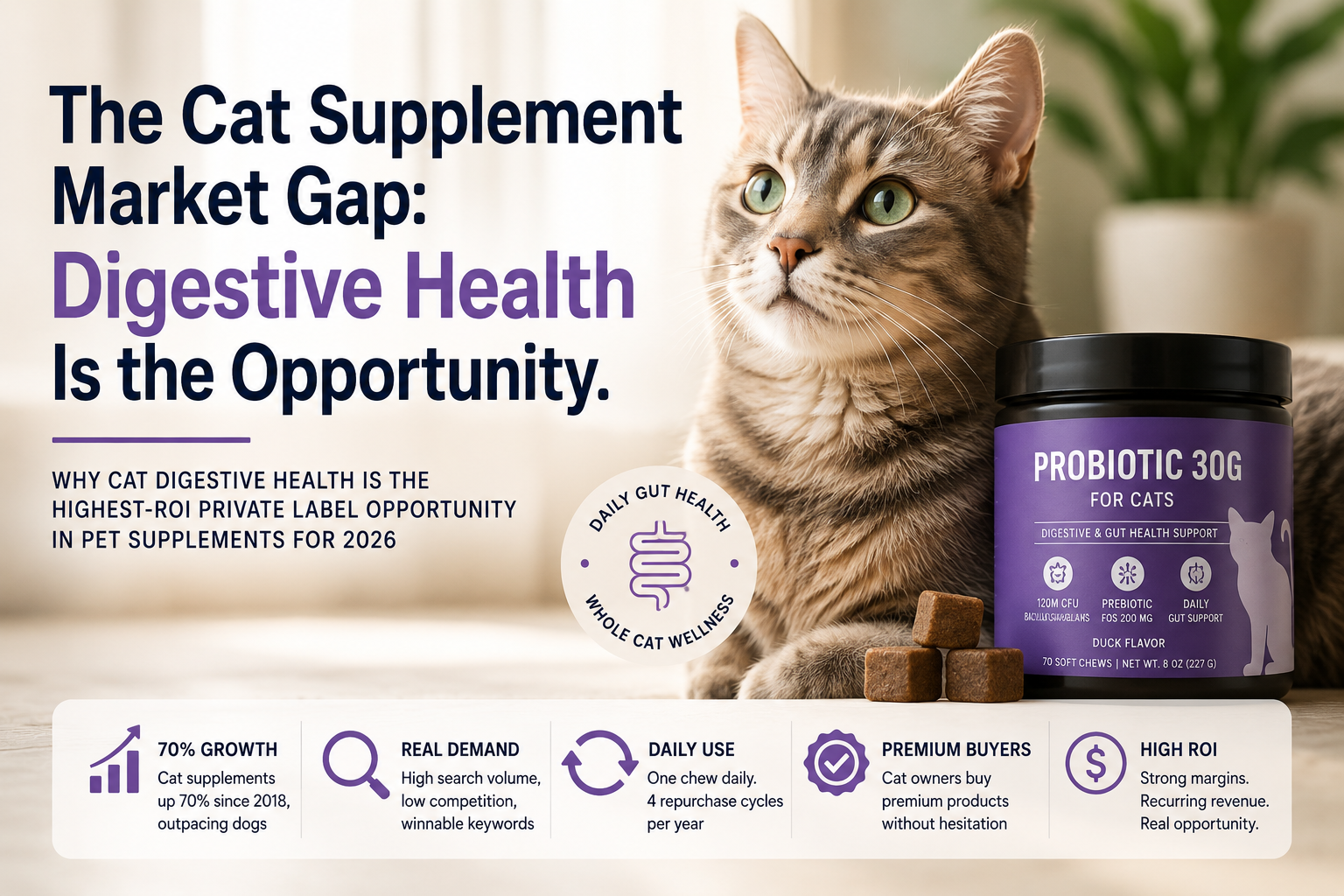
The 2026 pet supplement market has a gap, and it has whiskers.
Dog supplements dominate the conversation — the products, the search volume, the shelf space. Cat owners have been largely underserved, and the brands paying attention to that gap are quietly building recurring revenue in a category with real demand, lower competition, and a customer base that buys premium products without hesitation.
Cat digestive health is one of the clearest entry points into that opportunity.
The cat supplement market is growing faster than dogs, less crowded online, and full of premium buyers who are already searching. Here's why digestive health is the right entry point:
That is the opportunity. The brands that move now own the category before it gets crowded.
Start with the numbers. According to the American Pet Products Association, cat supplement purchases have increased 70% since 2018 — outpacing the already-strong 56% growth in dog supplements over the same period. There are 49 million U.S. cat-owning households, and 38% of cat owners already buy premium cat food. These are not bargain shoppers. They're premium buyers who have simply not been handed a great supplement option yet.
Only 34% of cat owners currently give their cats supplements, compared to 53% of dog owners. That gap is not a sign of disinterest — it's a sign of an underdeveloped market. The demand is there. The product selection that serves it well is not.
For a brand builder evaluating where to place a bet in the pet supplement space, that gap is the opportunity.
This isn't a category you'd have to educate consumers into. Cat owners are already looking. The search data is unambiguous:
What makes this particularly attractive from a content and SEO standpoint is the keyword difficulty. "Cat digestive health" sits at a KD of 28. "Gut health for cats" is KD 30. These are winnable positions for a brand willing to publish genuine educational content — the kind that answers the questions cat owners are already typing into Google.
Compare that to the dog side of the market, where "probiotics for dogs" pulls 33,100 searches per month but carries a KD of 64. The cat market has real volume with a fraction of the competition. That's a favorable ratio for any brand entering with a focused content and product strategy.
The buyers exist. They're searching. The shelf — both physical and digital — is not yet crowded with strong options built specifically for cats.
Not every supplement category creates a daily routine. Joint supplements get used situationally. Calming products spike around fireworks and travel. But a probiotic for cat digestive health is a daily product — one scoop or one chew every morning, built into the feeding routine, repurchased every 30 to 90 days without a second thought.
That repurchase behavior is what makes digestive health the right anchor category for a cat supplement line. The customer acquisition cost happens once. The revenue recurs.
There's also a broader wellness story to tell. Cat digestive health connects to immune function, coat condition, energy, and stool quality — outcomes that cat owners can see and feel over time. A product that delivers visible results earns loyalty in a way that a one-time-use product never can.
The palatability challenge is real and worth addressing directly. Cats are notoriously resistant to supplements. Pills get spit out. Oils get avoided. Powders get sniffed and walked away from. The format question isn't secondary — it's central to whether the product ever gets consumed consistently enough to produce results, and whether owners stick with it long enough to reorder.
This is where formula and format selection determine ROI as much as the marketing does.
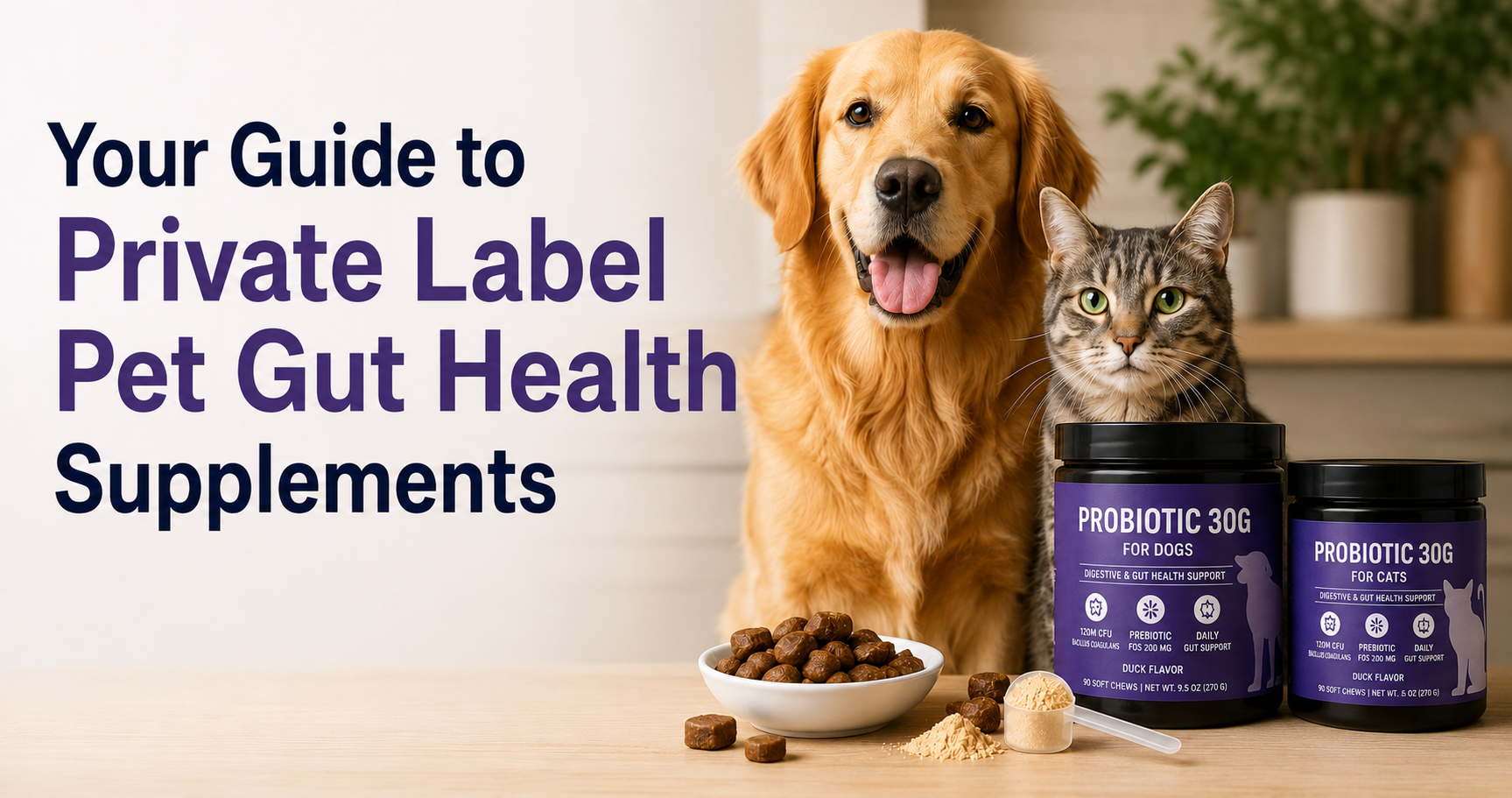
Pet Tech Labs' Probiotic 30G is a best-selling White Label formula available specifically for cats — and it addresses every challenge the category presents.
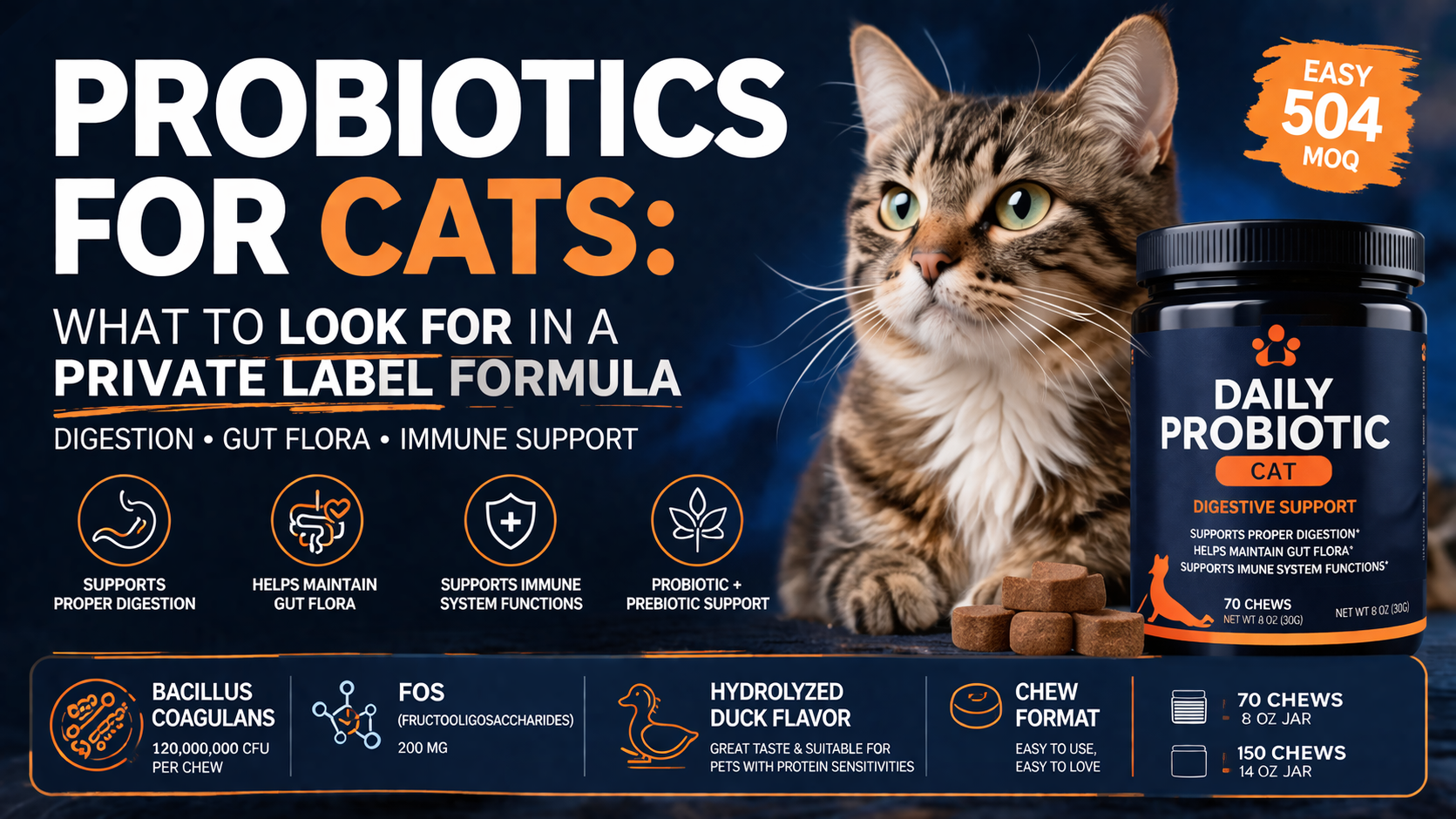
Bacillus coagulans is the only probiotic strain that survives the soft chew manufacturing process. Most probiotic strains are fragile — they die during heat processing, which means many probiotic products deliver far fewer live cultures than the label suggests by the time they reach the consumer. Bacillus coagulans is spore-forming, which makes it heat-stable and shelf-stable. What's on the label is what gets delivered.
FOS — fructooligosaccharides — is a prebiotic fiber that feeds the beneficial bacteria introduced by the probiotic. Without a prebiotic, probiotic bacteria have to compete with existing gut flora for resources. With FOS at 200mg per serving, the formula creates an environment where the introduced bacteria can establish and thrive. This is the difference between a probiotic and a synbiotic — and it's the science that separates a product with real outcomes from one that just checks a box on an ingredient deck.
The chew format uses hydrolyzed duck flavor — a protein that's been broken down to reduce allergenicity, making it appropriate for cats with common protein sensitivities. For finicky cats, the chew can be broken apart and mixed into wet food. The granule format is also available for brands that prefer that administration method, with an MOQ structure that makes it accessible for brands testing the cat market before scaling.
At a retail price point of $24.99–$34.99 for the 70ct, the margin structure is strong. At a 90-day supply per cat, the 150ct jar becomes the reorder unit — and the customer who starts on the 70ct and reorders the 150ct is a customer with demonstrated loyalty.

The White Label MOQ is 504 units per SKU. At 1,000 units — a modest second order — the per-unit cost on the 70ct drops to $6.31.
| Metric | Value |
|---|---|
| Unit cost (1,000 units, 70ct) | $6.31 |
| Retail price | $29.99 |
| Gross margin per unit | ~79% |
| Reorder cycle | Every 90 days (1 per cat) |
| Annualized revenue per customer | ~$120 (4 reorders × $29.99) |
| 500 active customers × annual revenue | ~$60,000 recurring/year |
That's before any bundling, subscription pricing, or line extension into a second cat SKU. A brand that acquires 500 active cat supplement customers is looking at roughly $60,000 in annual recurring revenue from a single product, with margin structure that supports profitable growth.
The cat market makes this possible because the competition for that customer hasn't yet driven acquisition costs to the levels seen in dog supplements.
Related Content: Run the ROI math with real figures. See what pet supplement manufacturing cost typically looks like across batch sizes.
The Probiotic 30G is a strong anchor, but the catalog supports a fuller cat wellness strategy. From the same White Label program:
A two-SKU launch — probiotic plus hairball — gives a new cat supplement brand a gut health anchor and a coat/GI companion product. A three-SKU launch adds the multivitamin and positions the brand as a full daily wellness line, not a single-use product.
All of it manufactured in the same cGMP-certified Vermont facility. All of it available at 504-unit MOQ per SKU to start.
Step 1: Choose your SKUs. Start with the Probiotic 30G for Cats. Add Hairball (31G) if you want a two-product launch. Submit your brand logos and artwork.
Step 2: Approve your label. Pet Tech Labs handles production. You review and approve before anything goes to print.
Step 3: Place your order. 504 units minimum. Timeline is weeks, not months.
Step 4: Build content around the search terms buyers are already using. "Cat digestive health," "gut health for cats," "probiotics for cats" — these are winnable keyword positions for a brand willing to publish genuine educational content. The SEO opportunity is as real as the product opportunity.
Step 5: Collect reorders. A cat owner who sees results in 30 days reorders without being asked. That's the business model.
Cat digestive health is a market where search volume is real, keyword difficulty is still manageable, the product shelf is underdeveloped, and the customer is already a premium buyer. That combination doesn't stay in place indefinitely. As more brands recognize the gap, the space gets more competitive and the cost of entry — in both advertising and SEO — goes up.
The brands that move now get to own the category before it gets crowded.
To explore private label cat supplements or review the full catalog, connect with the Pet Tech Labs team. For brands evaluating a larger custom formulation, pet supplement contract manufacturing starts at 400 lbs MOQ through the Premium Program. Either way, the starting point is the same: private label pet supplements.

The White Label program at Pet Tech Labs starts at 504 units per SKU. This is designed as an accessible entry point for emerging brands testing the cat supplement market before committing to larger inventory. The Probiotic 30G for Cats is available in 70ct and 150ct jar sizes — both eligible at the 504-unit MOQ.
Most probiotic strains are fragile and die during the heat and pressure of soft chew manufacturing. Bacillus coagulans is spore-forming, which makes it uniquely heat-stable — it survives production, remains shelf-stable in the jar, and delivers live cultures at the point of digestion. It is the only probiotic strain that can be successfully incorporated into a soft chew format while maintaining potency.
Yes. Pet Tech Labs offers the Probiotic 30G for both cats and dogs, with species-specific SKUs and pricing. The core formula — Bacillus coagulans at 120,000,000 CFU and FOS at 200mg per chew — is the same across species. The cat version is dosed at 1 chew daily regardless of body weight, simplifying the dosing instruction on the label.
The White Label process is designed for speed. Once you've selected your SKUs, submitted your brand artwork, and approved your label, the timeline to shipment is typically measured in weeks — not months. This is a core advantage over custom formulation, which requires an R&D development cycle that can run six months or longer before a product is ready for production.
Pet Tech Labs, a FoodScience Company, manufactures in a cGMP-certified Vermont facility that holds SQF (Safe Quality Food) certification. The company is a founding member of NASC (National Animal Supplement Council) and holds USDA APHIS export certifications for international markets. These certifications represent the compliance infrastructure that brand partners inherit when they launch under the Pet Tech Labs White Label program.
The Pet Tech Labs catalog includes several cat-specific White Label formulas that pair naturally with the Probiotic 30G. Hairball for Cats (31G) addresses coat health and GI function using Omega fatty acids, psyllium husk, and biotin. Multivitamin for Cats (29F) provides a complete vitamin and mineral foundation with taurine. Litter Box Support (791) targets fecal odor reduction and is a category-specific differentiator with no direct dog equivalent. Each is available at 504-unit MOQ.
The cat supplement market has meaningful search volume — "probiotics for cats" pulls nearly 10,000 searches per month — but keyword difficulty scores remain low to moderate across the category. "Cat digestive health" carries a KD of 28 and "gut health for cats" a KD of 30. By comparison, "probiotics for dogs" has a KD of 64 and is dominated by established brands with large content and backlink profiles. A brand publishing genuine educational content around cat gut health today can realistically rank in positions that would take years to reach on the dog side of the market.
What Are the Best Supplements for Aging Dogs and Cats? Pet owners want safe, daily solutions that...
Pet Tech Labs Team
Science has made incredible recent discoveries about the profound effects of microbiome health on...
Pet Tech Labs Team
A lot of probiotics for cats sound better on the front of the label than they do under a closer...
Pet Tech Labs Team
The pet supplement market has crossed into the mainstream. According to the American Pet Products...
Pet Tech Labs Team
Pet Tech Labs® sets the gold standard for companies looking for top-quality pet supplements and private labeling or contract manufacturing solutions
Pet Tech Labs® is part of the FoodScience® family of brands. Learn more at foodsciencecorp.com