
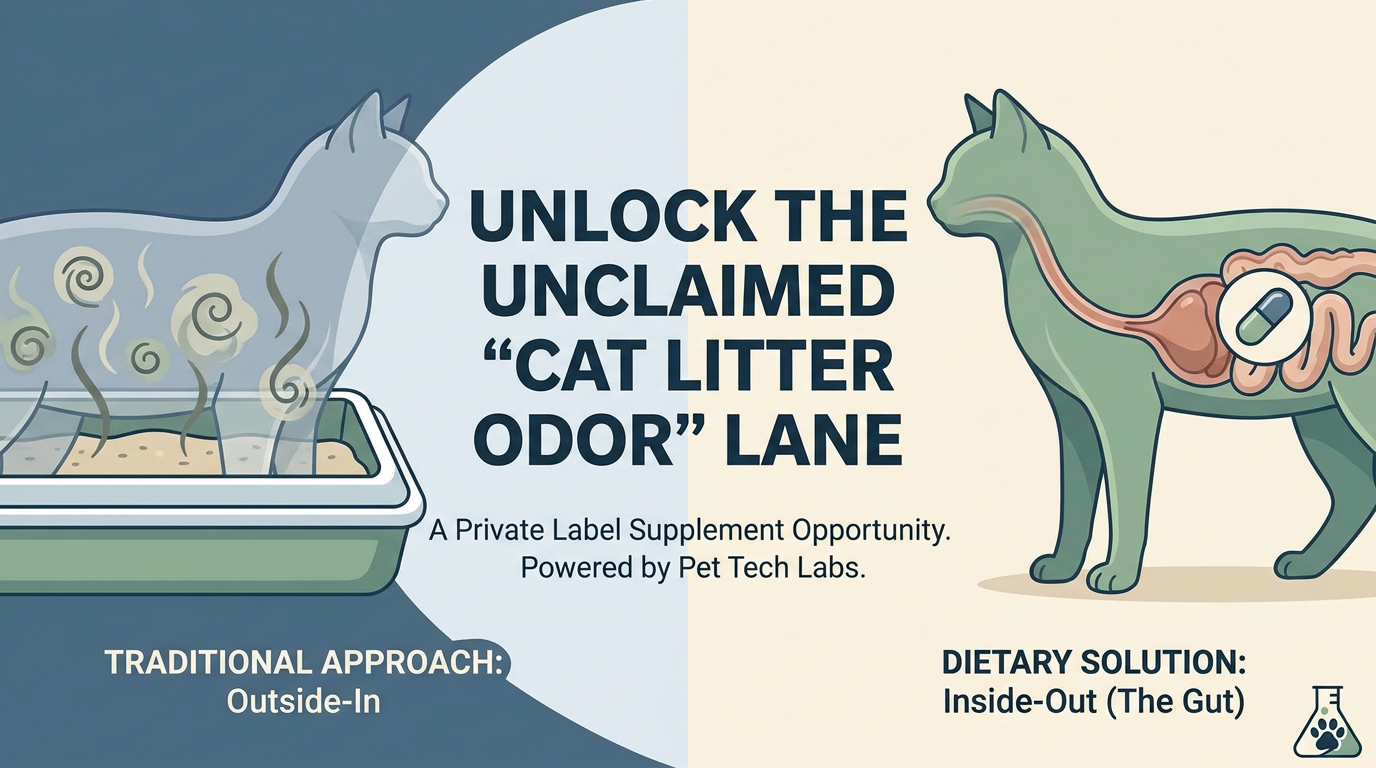
There are over 8,000 monthly searches across the cat litter odor control keyword cluster. The top ten results for "cat litter odor control" are Amazon listings, Tidy Cats at Kroger, a Tractor Supply litter roundup, Chewy retail pages, and a 2006 NIH study on a litter box spray. Below that: Caterpillar construction equipment, the Linux cat command, and a New Yorker fiction piece. Not one supplement brand appears anywhere in those results. Not one dietary solution. Not a single piece of content that addresses litter box odor from the inside. For a private label cat supplement brand, that absence is the opportunity.
TL;DR: The cat litter odor control keyword cluster has 8,000+ monthly searches and is owned entirely by litter brands, sprays, and retail pages. The reason is that the entire market approaches the problem from the outside, attacking odor compounds after they have already been excreted. A dietary supplement works differently: it works on the gut, reducing the ammonia, sulfur compounds, and fecal malodors before they reach the litter. Pet Tech Labs has the formula. No private label supplement brand has claimed this content space. That is exactly the kind of lane a well-positioned brand should be running in.
Most cat owners treat litter box odor as a litter problem. They buy odor-control litter, add deodorizer sprays, replace the litter more frequently, or invest in covered boxes and air filtration. These approaches have one thing in common: they all engage with the odor after it has already been produced and deposited.
The chemistry behind litter box malodor tells a different story. The dominant compounds responsible for the smell (ammonia, hydrogen sulfide, methyl mercaptan, and other sulfur-based compounds) are not created in the litter box. They are produced inside the cat's digestive tract during digestion and bacterial fermentation, then excreted as waste. By the time those compounds reach the litter, they are already formed. Litter products, sprays, and deodorizers can mask or neutralize them at the surface, but they cannot prevent them from being produced in the first place.
That distinction matters enormously from a brand positioning standpoint. Every product currently ranking for cat litter odor control is competing on the same axis: how effectively does it neutralize odor at the box? The brands winning that competition are companies like Purina, Arm and Hammer, and Clorox, companies with category dominance, retail shelf presence, and marketing budgets that dwarf any emerging brand's resources. A private label supplement brand trying to enter that competition is starting at a massive structural disadvantage.
The more interesting question is the one none of those brands are asking: what if you reduced malodor production inside the cat before excretion? That question has an answer, and it is where the private label supplement opportunity lives.
The inside-out approach to cat litter odor control is based on a simple premise: if the odor compounds are produced in the gut, the most effective intervention point is the gut. Not the litter. Not the air above the litter box. The intestinal environment where ammonia and sulfur compounds originate.
This is not a novel concept in animal nutrition. Ingredients that reduce gut-derived malodors have been used in livestock and companion animal nutrition for years. What has not happened is any supplement brand applying this framework specifically to the cat litter odor control keyword category, building a content strategy around it, and positioning a White Label product as the dietary solution to a problem cat owners search for constantly.
Pet Tech Labs' Litter Box Support formula is built around three active ingredients, each working upstream of the litter box. Champex™, Yucca schidigera extract, and Spirulina with naturally occurring Chlorophyll work through distinct mechanisms, all of them focused on reducing odor production at its source rather than masking it after excretion. Two chews daily. Chicken liver flavor. A daily routine rather than a reactive product.
For a brand builder, the positioning is the differentiator. This is not a product competing with Fresh Step or Dr. Elsey's. It is a product offering a categorically different solution to the same problem, one that no litter brand can replicate and no litter brand is currently offering. That is what a lane of one looks like in the supplement category.
The mechanism behind the inside-out approach depends on understanding what each ingredient does in the digestive tract, not at the litter box surface. This ingredient science is also the information gain that no competing content in this SERP provides, and it is what separates a credible brand story from a generic claim.
Champex™ is a patented commercial ingredient derived from champignon mushrooms. It has been specifically developed to help reduce ammonia production in the gut by working on the intestinal bacteria responsible for ammonia generation. Ammonia is the primary contributor to that sharp, penetrating smell associated with soiled litter. A formula that helps reduce how much ammonia the cat produces internally is working on that problem at its biochemical origin rather than attempting to absorb or mask it after the fact. This ingredient is used in both human and animal supplement categories for exactly this purpose, which gives it a track record and a meaningful story to tell on a product label.
Yucca schidigera extract works through a different mechanism. The plant contains steroidal saponins, naturally occurring compounds that bind to ammonia and other nitrogen-based odor molecules in the digestive tract before they are excreted. By binding to these compounds in the gut, Yucca schidigera helps reduce the concentration of malodorous nitrogen compounds at the point of elimination. It is one of the most widely used ingredients in animal nutrition for odor reduction precisely because this mechanism is well understood and well documented in the animal feed industry.
Spirulina contributes naturally occurring Chlorophyll, which has documented internal deodorizing properties recognized across both human and animal nutrition. The formula delivers 100mg of Spirulina per chew, yielding 2mg of Chlorophyll, as a daily compound that complements the ammonia-reduction mechanisms of the other two ingredients.
Together, these three ingredients address cat litter odor control from three distinct upstream angles simultaneously. None of them engage with the litter box. All of them engage with the gut environment where odor compounds originate. A brand that explains this clearly, in plain language, with the ingredient science behind it, is telling a story that none of its competitors in the litter aisle can tell.

The search demand for cat litter odor solutions is not niche. It is a consistent, year-round category driven by a problem every indoor cat owner lives with. The cluster below represents what people are actively searching for, and what is currently being being served exclusively by litter products.
| Keyword | Monthly Volume | Keyword Difficulty |
|---|---|---|
| cat litter odor control | 1,900 | 18 |
| litter box odor control | 1,300 | 27 |
| litter box deodorizer | 1,300 | 26 |
| cat litter smell | 590 | 26 |
| how to get rid of litter box smell | 590 | 27 |
| litter box odor eliminator | 390 | 26 |
| litter box odor | 390 | 28 |
| cat poop smell | 390 | 29 |
| litter box smell | 320 | 23 |
| how to reduce litter box smell | 260 | 31 |
The primary keyword, "cat litter odor control," carries a keyword difficulty of 18, which is relatively low for a cluster with nearly 2,000 monthly searches on a single term. The reason for that low difficulty is apparent in the SERP: the results are dominated by product listings and retail pages, not well-structured editorial content. A supplement brand publishing a focused, well-built piece about the dietary approach to cat litter odor control is not just entering an underserved space. It is entering a space where the most authoritative editorial voice does not yet exist.
The business case compounds when you consider the positioning. A brand ranking for these searches is not competing with litter companies on their terms. It is presenting a categorically different solution to the same problem and reaching the same motivated audience. The cat owner searching for how to get rid of litter box smell has already tried litter. The supplement is the next conversation, and right now, nobody is having it.
The inside-out story becomes even more compelling when a second product enters it. Gut flora composition has a direct effect on the types and volumes of malodorous compounds produced during digestion. A microbiome that is healthy and diverse produces fewer of the fermentation byproducts responsible for fecal odor. A microbiome that is stressed, disrupted, or imbalanced produces more of them.
A probiotic formula works on exactly this variable. By supporting healthy gut flora through Bacillus coagulans and FOS prebiotic, a daily probiotic works on the microbial environment that produces odor compounds in the first place. Combined with a fecal odor support formula targeting ammonia production and binding, the two products tell a coherent story: one addresses the microbial environment, the other addresses the specific compounds that environment generates. Brands carrying both can position them as a complete inside-out gut health approach rather than two unrelated SKUs on a product page. The full framework for the probiotic category opportunity is covered in the companion articles on probiotics for cats and cat digestive health supplements.
Pet Tech Labs is a private label and contract manufacturing partner for the pet supplement category, operating as part of FoodScience with more than 50 years of nutritional formulation history. Both manufacturing facilities are SQF-certified and compliant with cGMP manufacturing standards. All products undergo third-party ingredient testing. Products are manufactured in the USA. Pet Tech Labs has been a founding member of the National Animal Supplement Council since its inception.
The Litter Box Support formula is available through the White Label program: two soft chews daily, chicken liver flavor, 70-count and 150-count jars. The five-step White Label process covers product selection, artwork, label approval, order, and shipment: a fast path to market for a brand entering a category with no existing dietary competition. Explore the full range of private label pet supplement options or reach out to a Pet Tech Labs specialist to get started.

FAQ: Cat Litter Odor Control and the Supplement Opportunity
What causes cat litter box odor?
The primary malodor compounds in soiled cat litter (ammonia, hydrogen sulfide, methyl mercaptan, and other sulfur-based compounds) are produced inside the cat's digestive tract during digestion and bacterial fermentation. They are not created in the litter box; they arrive there via excretion. Litter products and sprays address these compounds after excretion. A dietary supplement works upstream, on the gut processes that generate those compounds in the first place.
Can a cat supplement actually help reduce litter box smell?
Yes, through a different mechanism than litter products use. Ingredients like Champex™ (champignon mushroom extract) work by helping to reduce ammonia production in the intestinal tract. Yucca schidigera helps bind ammonia and nitrogen-based odor compounds in the gut before they are excreted. Spirulina with naturally occurring Chlorophyll provides internal deodorizing support. These mechanisms work upstream of the litter box rather than at it, which is why the approach is categorically different from any litter-based odor control product.
How does Yucca schidigera help with cat litter odor?
Yucca schidigera contains steroidal saponins, natural compounds that bind to ammonia and other nitrogen-based malodor molecules in the digestive tract before they are excreted. By binding to these compounds in the gut, Yucca schidigera helps reduce their concentration at the point of elimination. It is one of the most well-established ingredients in animal nutrition for this purpose, with a documented history of use in both livestock and companion animal applications.
What is Champex and how does it work for cats?
Champex™ is a patented commercial ingredient derived from champignon mushrooms. It is specifically formulated to help reduce ammonia production in the gut by working on the intestinal bacteria responsible for generating ammonia during digestion. Ammonia is a primary driver of litter box odor. A formula that helps reduce how much ammonia is produced internally addresses the problem before it ever reaches the litter box. Champex™ is used in both human and animal supplement categories for gut-derived odor reduction.
How is a dietary supplement different from a litter deodorizer?
A litter deodorizer works externally, at the litter box surface, after odor compounds have already been excreted. It masks or neutralizes those compounds after the fact. A dietary supplement works internally, in the cat's gut, to help reduce the production of those same compounds before excretion occurs. The two approaches are not in competition: one is reactive and external, the other is proactive and internal. For a supplement brand, this distinction is the entire positioning strategy: you are not in the litter aisle, and you are not competing with litter brands.
How long does it take for a litter odor support supplement to work in cats?
Most cat owners who use dietary odor support supplements notice changes within one to two weeks of consistent daily use, as the ingredients work cumulatively on the gut environment. Results depend on the individual cat's diet, microbiome, and consistency of supplementation. Because this is a daily wellness product rather than an acute treatment, consistent use is what produces and maintains results. This also means there is no defined endpoint. Daily supplementation supports ongoing odor reduction for as long as it is given.
Can I use both a probiotic and a litter odor support supplement for my cat?
Yes, and for brands, this pairing makes strong commercial sense. A probiotic supports healthy gut flora, which produces fewer malodorous fermentation byproducts. A fecal odor support formula addresses the specific compounds (primarily ammonia and sulfur compounds) that result from gut bacterial activity. The two products address complementary aspects of the same inside-out approach, which allows a brand to position them together as a gut health system rather than two separate, unrelated products.
What is the correct dose for a litter odor support supplement for cats?
Pet Tech Labs' Litter Box Support formula is directed at two chews daily for all cats. The soft chew format with chicken liver flavor is designed for daily routine compliance. Unlike weight-based dosing that complicates some other supplement categories, the two-chew daily direction is consistent across cat sizes, which simplifies the feeding routine and reduces the barriers to daily use. Available in 70-count and 150-count jars to suit different household sizes and purchasing preferences.
Is there a private label opportunity in the cat litter odor control category?
Yes, and the keyword data shows exactly why. "Cat litter odor control" generates 1,900 monthly searches at a keyword difficulty of 18. The broader cluster exceeds 8,000 monthly searches across related terms. Every result currently serving those searches is a litter brand, retail listing, or spray product. No supplement brand appears anywhere in the top results for any term in this cluster. A private label brand that launches a dietary litter odor support product and builds content around the inside-out mechanism enters a category with proven search demand and zero supplement competition.
What makes litter box odor so difficult to control with litter alone?
Because litter addresses the problem after the fact. The odor compounds (ammonia, hydrogen sulfide, and sulfur-based molecules) are produced during bacterial fermentation in the cat's digestive tract and deposited into the litter via excretion. Even the best odor-control litter is working to neutralize or mask compounds that have already been fully formed. Certain dietary factors, microbiome composition, and protein metabolism all influence how many of those compounds a cat produces. Litter cannot address any of those upstream variables. A dietary supplement can, which is why the two approaches are complementary rather than competitive.
Tags:

Pet Tech Labs® sets the gold standard for companies looking for top-quality pet supplements and private labeling or contract manufacturing solutions
Pet Tech Labs® is part of the FoodScience® family of brands. Learn more at foodsciencecorp.com